[ad_1]
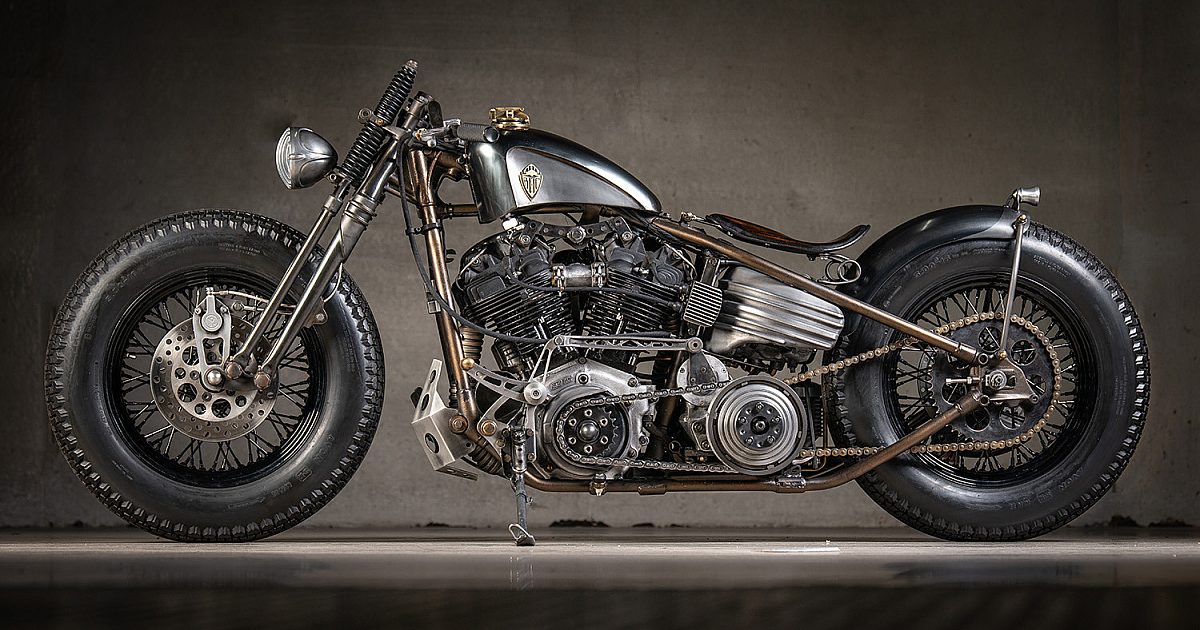
So you like old Harleys, do ya? Well, clearly you do, as February’s stats don’t lie. Relax, your secret’s safe with us, and every member of the Bike EXIF staff has at least one old HD in the stable in addition to the daily drivers.
While February’s numbers confirm a trend we’ve been noticing for the last year, we welcome all kinds around here, and our top performers include a seemingly showroom BSA and a wild two-stroke Honda Grom as well. So join us, if you will, for a victory lap for last month’s most viral custom motorcycles—V-twin or otherwise.
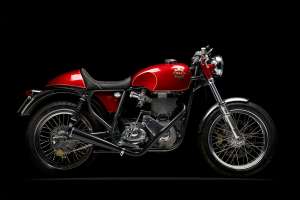
BSA Gold Star Café Racer by Metal Malarkey
Sometimes the best customs pull you in two directions at once: they respect heritage but refuse to be a museum piece. That’s exactly the vibe of this BSA Gold Star café racer from England’s Metal Malarkey Engineering. The Gold Star’s reputation as a quintessential British café donor is well earned, but rather than lean on an old survivor, the team built a brand new interpretation from the ground up—right down to the bespoke frame and near-new engine.
Instead of reusing a vintage chassis, Metal Malarkey drew inspiration from the classic Metisse Mk3, fabricating a cold-drawn seamless steel frame with elegant bronze welds and a matching one-off oval swingarm. The powerplant is a fresh machine from Dutch specialists ABSAF, built in the spirit of the late-’50s DBD34 Gold Star but upgraded with modern internals. Highlights of the engine’s spec sheet include a relocated spark plug, modded ports, forged piston, stainless valves, Nikasil liner and heavy-duty bearings, all paired with a five-speed Nova gearbox.
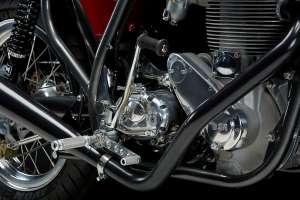
Underneath the classic lines you’ll find replica Ceriani 38 mm forks, bespoke Maxton rear shocks, 18-inch wheels with Talon hubs, Avon Roadriders and Brembo brakes on handmade mounts. The bodywork blends sourced parts and custom fabrication: a Lyta-style fuel tank and café racer seat cowl from Tab Classics sit above a custom-fabbed oil tank and stainless fenders.
The cockpit strikes a balance between era homage and modern usability, with Brembo levers, Oberon LED bits, Biltwell grips and twin Smiths gauges blending analog charm with contemporary practicality. A tasteful candy-red and gold livery by Graham’s Garage and Lee Morgan Artworx rounds out a build that could easily pass for a meticulous restoration—except this one is new. [More]
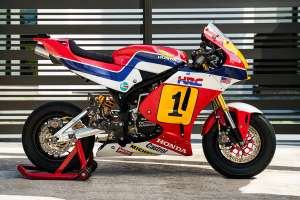
Honda Grom Street Racer by Cohn Racers
The Honda Grom is already one of motorcycling’s most endearing oddities—a tiny, grin-inducing mini-moto that launched an expansive aftermarket and scores of imaginative builds. For Florida’s Cohn Racers it was the perfect canvas for a fun diversion from their usual work. Known for burly Sportster scramblers, the team decided to turn a 2019-model Grom into something unexpected: a pint-sized street racer with real two-stroke character and genuine performance intent.
Rather than chase headlines with an oversized engine that would overwhelm the frame, builder Chet Perez chose a Yamaha YZ125 two-stroke engine as the heart of this project. That choice was purposeful—light, lively and linked to racing DNA—but it introduced the classic challenge of vibratory chaos in such a small chassis. The solution was a fully rubber-mounted engine setup, machined with custom brackets that isolate harsh two-stroke vibes while maintaining alignment and rigidity.
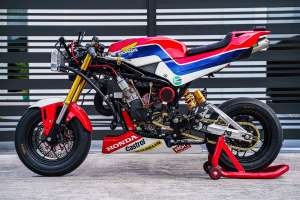
This isn’t just an engine transplant with half-hearted parts bolted on. A bespoke front intake and Pro Circuit-derived exhaust with an Akrapovič silencer articulate the engine’s performance, while a Boyesen Factory Racing cover and Polisport protection pieces show that function was a priority. Cooling was rethought, too, with a relocated water-cooling system positioned for direct airflow to keep temps in check under hard riding.
The chassis modifications are just as deliberate. Öhlins suspension at both ends elevates the handling well beyond stock, the custom aluminum swingarm adds strength and purposeful track geometry, and upgraded Brembo brakes with oversized discs and braided lines make sure the tiny package stops with authority.
Cosmetically, it wears a full fiberglass body kit sourced from Asia, which Cohn revised with improved rubber mounting to reduce vibration and improve refinement. A traditional HRC-inspired paint scheme reinforces the racing intent, while carbon accents, CNC rear sets from Neverland and an Alcantara-covered seat bring quality to every touchpoint. On the road, the bike lives up to that character: explosive power delivery, sharp handling and surprising composure from a platform most people write off as a toy. [More]
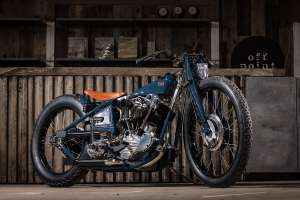
Knucklehead Board-Track Racer by Infinity Inc.
Masumi Tsuchino of Infinity Inc. was invited by S&S Cycle to build a bike for the Japanese leg of the S&S Cycle Vintage Tour and chose a brand‑new S&S KN93 Knucklehead engine for his entry, despite never having worked with a Knuckle before. Out of gratitude for the opportunity, Tsuchino imagined what an S&S-fielded board tracker from the 1920s would look like, but clearly the scope of the project extends beyond appearances.
Upon receipt, Tsuchino sent the Knucklehead engine to Tamamura Motors for a performance overhaul, paired it with a six‑speed Baker transmission and S&S Super B carbs, and polished all the cases while it was apart. A 1936 Knucklehead replica frame from V‑Twin Manufacturing became the backbone, but Tsuchino reshaped the front end with a British 1940s Ambassador 250 girder fork at a steep rake to compress the wheelbase and tighten the stance.
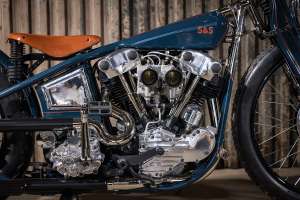
Wheels are period‑correct 28‑inch front and 26‑inch rear board‑track rims laced to vintage‑style drum hubs, with refurbished linings for usable braking. The narrow front forks even required machining the hub to fit. The rear triangle was reshaped to snug up around the narrow tire, resulting in an asymmetrical frame hidden by the bespoke exhaust, which references 1920s race bikes and vintage Knucklehead mufflers.
Masumi fabricated an ultra‑slim custom fuel tank that echoes classic split-tank styling, while incorporating a tiny motogadget speedo embedded in the backbone tube. Under the seat is a handmade box housing oil and electronics. A 1920s‑style saddle, abbreviated rear fender, bespoke bars with modified grips and a small triangular headlight complete the build.
Unlike many period‑inspired builds that opt for foot clutches and hand shifters, Tsuchino retained a conventional see‑saw foot shifter beside the BDL primary, prioritising ease of use. Painted by New Classic Painting and finished with tasteful sign work by Rio Studio, the result is the slimmest bike Infinity has built and a standout board tracker that stays true to its imagined era. [More]
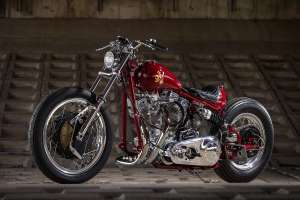
1978 Harley-Davidson FLH by Fatech
Minoru Watanabe of Fatech has built a reputation on bikes that blend traditional custom Harley cues with hot-rod influences. This one—based loosely on a 1978 Harley-Davidson FLH—is no exception. Dubbed Sol Invictus, the bike was rebuilt around a handmade twin-down-tube frame with a dramatically sloping backbone and a one-off asymmetrical swingarm designed to keep the stance low while still providing rear suspension.
The rear end is the bike’s visual party trick. From the right side, the rear wheel appears almost unsupported, floating behind the engine. Only when you circle the bike do you see how Watanabe pulled it off—a braced swingarm and a horizontally mounted Öhlins shock tucked neatly along the frame. Up front, a set of chromed Ceriani forks hold a 19-inch wheel with a massive 250 mm Fontana drum brake, while Borrani rims and the classic combo of an Avon Speedmaster front tire and Firestone Champion Deluxe rear keep the vintage racing vibe intact.
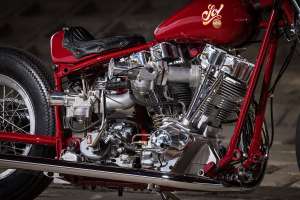
The engine started life as a stock Shovelhead but was treated to a thorough performance refresh. Inside are Carrillo rods and Truett & Osborn components, along with WPC-coated pistons and a Dynatek ignition. A pair of S&S Cycle Super B carburetors feed the motor, while the gearbox was rebuilt with Andrews Products internals and spins through a chunky three-inch primary drive.
Almost everything else on the bike was shaped by hand. Twin fuel tanks sit over the engine, joined by a center strip with a mesh window detail, while the compact tail section doubles as the oil tank. The cockpit mixes narrow bars with refurbished 1960s controls, Tomaselli grips, a Smiths speedometer and a vintage 4.5-inch headlight.
Paint by Shakin’ Speed Graphix finishes the bike in deep burgundy with chrome accents, gold logos and subtle striping. The name Sol Invictus—Latin for ‘unconquered sun’—feels fitting for a machine that blends classic Harley style with the kind of inventive engineering that’s become Fatech’s signature. [More]
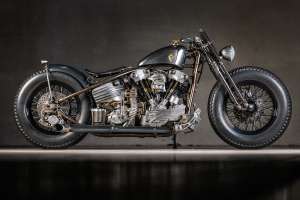
Harley Knucklehead Bobber by Bull Motor Company
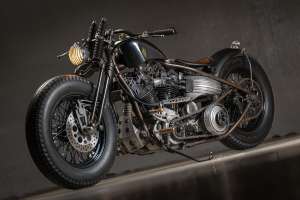
The Harley-Davidson Knucklehead engine has always carried a certain mythos. Nearly ninety years after its debut, the silhouette of those distinctive rocker boxes still signals the birth of the modern Big Twin—and the foundation for generations of bobbers and choppers. That legacy is why Justin Powers from Bull Motor Company has been fielding the same request from customers for years—a Knucklehead-style bike that keeps the early Big Twin aesthetic without the quirks that make original machines difficult to live with. Instead of building them one at a time, Bull Motor Company committed to a small production run built around proven components, even offering the rare promise of a warranty.
The foundation is an OE-style Harley FL wishbone frame, the same basic architecture used on Big Twins from the late 1940s through the early ’50s. Up front sits a traditional springer fork fitted with inverted speedster bars and a scalloped headlight bucket, while a Performance Machine disc brake adds a dose of real-world stopping power. Spoked 16-inch wheels wrapped in Avon Safety Mileage tires keep the stance firmly rooted in classic bobber territory.
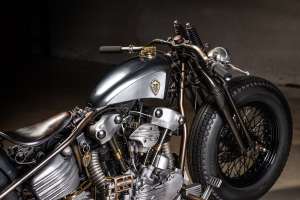
Power comes from an S&S Cycle KN93 engine—a modern take on the Knucklehead that preserves the iconic look while adding practical improvements. Displacement climbs to 93 cubic inches and the updated bottom end and oiling system address some of the longevity issues that plagued original motors. Fuel and spark are handled by an S&S Super E carburetor and Super Stock electronic ignition, with power sent through a Baker four-speed and open chain final drive.
The bodywork sticks to bobber fundamentals: a solo saddle, a tidy bobbed rear fender and a scalloped fuel tank that highlights the engine’s signature rocker boxes. The oil tank is an unexpected touch—based on a Harley FXCW Rocker unit that was narrowed by four inches and recast to fit the FL frame, giving the bike a finned centerpiece beneath the seat.
Where the build really separates itself is in the finish. Inspired by the patina of a Colt M1911 pistol, many of the metal parts were chemically treated with a black-oxide process similar to gun bluing. Combined with aged aluminum, brass accents and a bronze-toned frame, the result is a machine that looks decades old despite having no paint anywhere on it. [More]
[ad_2]
Source link